The AI Revolution in ERP: Navigating a New Era of Business Transformation.
AI is revolutionizing ERP. We dive into the critical issues: protecting your data from new AI-specific cyberattacks, staying competitive in an automated world, and preparing your workforce for the future of work. Get a clear analysis of the top concerns and concrete steps to lead your organization through this transformation successfully.
Bruce Franco
6/11/202510 min read
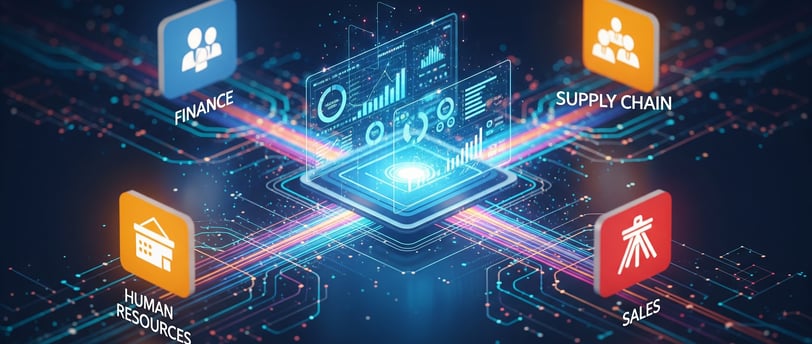
The race to integrate Artificial Intelligence (AI) into Enterprise Resource Planning (ERP) systems is well underway, with industry behemoths and agile startups alike vying for a competitive edge. This rapid adoption is not merely a technological trend but a fundamental shift in how businesses operate, promising unprecedented levels of efficiency, insight, and automation. However, this transformative wave is also creating significant ripples of concern, particularly in the realms of cybersecurity, market dynamics, and the future of the workforce. As companies embed AI deeper into their core processes, they grapple with the dual realities of immense opportunity and substantial risk. The strategic decisions made today by these ERP bigwigs will undoubtedly shape the business landscape for years to come, determining not only their own success but also the very nature of work and competition in the digital age.
Top 3 Cybersecurity Concerns of AI in ERP
The integration of AI into ERP systems, while offering powerful capabilities, introduces a new and complex threat landscape. These systems are the central nervous system of an organization, housing its most critical data. The addition of AI, with its data-hungry algorithms and autonomous decision-making, amplifies existing vulnerabilities and creates novel ones. The top cybersecurity concerns revolve around the sanctity of data, the integrity of AI models, and the potential for sophisticated new attack vectors.
1. Data Poisoning and Model Manipulation
One of the most insidious threats to AI-powered ERP systems is data poisoning. These systems rely on vast datasets to train their machine learning models for tasks such as demand forecasting, financial analysis, and inventory management. An attacker can intentionally inject malicious or biased data into the training set, subtly corrupting the model's logic. For instance, a competitor could manipulate sales data to skew demand forecasts, leading to overproduction or stock shortages. According to a 2023 report by the European Union Agency for Cybersecurity (ENISA), data poisoning attacks are becoming increasingly sophisticated and difficult to detect, posing a significant threat to the integrity of AI-driven decision-making.
The consequences of a successful data poisoning attack can be catastrophic. A tainted financial model might approve fraudulent transactions or provide misleading reports to executives, leading to poor strategic decisions and significant financial losses. The subtlety of these attacks lies in the fact that the AI model may appear to be functioning correctly, with the erroneous outputs being attributed to normal market fluctuations or other external factors. The black-box nature of many complex AI models further exacerbates this issue, making it challenging to audit their decision-making processes and identify the source of the corruption.
2. Adversarial Attacks and Evasion Techniques
Adversarial attacks represent another critical vulnerability for AI in ERP. In this scenario, attackers craft malicious inputs that are designed to deceive a trained AI model. For example, a fraud detection system could be tricked into classifying a fraudulent invoice as legitimate by making imperceptible alterations to the input data. Researchers have demonstrated that even minor, human-unnoticeable changes to data can lead to significant misclassifications by AI systems. A study published in the IEEE Transactions on Information Forensics and Security highlighted that adversarial examples could be crafted to bypass network intrusion detection systems with a high success rate.
The implications for ERP systems are profound. An attacker could exploit this vulnerability to bypass security controls, gain unauthorized access to sensitive information, or manipulate automated workflows. For instance, an adversarial attack on an inventory management system could lead to the unauthorized release of goods or the manipulation of stock levels. As AI becomes more integrated into real-time operational processes, the window of opportunity for detecting and responding to such attacks narrows, increasing the potential for significant damage.
3. Data Privacy and Confidentiality Breaches
The immense data appetite of AI models in ERP systems raises significant data privacy and confidentiality concerns. These systems process and store a wide range of sensitive information, including financial records, customer data, employee details, and proprietary business strategies. The very process of training AI models often requires access to large, centralized datasets, creating a high-value target for cybercriminals. A breach of this central data repository could have devastating consequences, leading to financial loss, reputational damage, and regulatory penalties under frameworks like the General Data Protection Regulation (GDPR) and the California Consumer Privacy Act (CCPA).
Furthermore, there is the risk of "model inversion" attacks, where an attacker can infer sensitive training data by repeatedly querying the AI model. For example, by analyzing the outputs of a predictive analytics model for customer churn, an attacker might be able to reconstruct sensitive customer profiles. The increasing use of cloud-based ERP solutions, while offering scalability and flexibility, can also expand the attack surface and introduce additional data security challenges. According to a recent survey by a leading cybersecurity firm, 62% of organizations are concerned about the security of the data used to train their AI models.
Business Competitiveness in the Age of AI-Powered ERP
The integration of AI is not just an upgrade to ERP systems; it is a fundamental re-architecting of how businesses compete. Companies that successfully leverage AI within their ERP frameworks can achieve a significant competitive advantage through enhanced operational efficiency, superior decision-making, and the ability to innovate at a faster pace. This shift is creating a new paradigm of competition where data-driven insights and automated processes are the cornerstones of market leadership.
1. Hyper-Automation and Process Optimization
AI-powered ERP systems are driving a new wave of hyper-automation, where not just repetitive tasks but also complex workflows are automated. Robotic Process Automation (RPA) bots integrated with AI can handle tasks like invoice processing, order fulfillment, and financial reconciliation with greater speed and accuracy than human employees. A 2024 report by a major consulting firm found that companies implementing AI-driven automation in their ERP systems have seen an average of a 25% reduction in operational costs and a 30% improvement in process efficiency.
This level of automation frees up human capital to focus on more strategic, value-added activities such as customer relationship management, product innovation, and long-term business planning. For example, in a manufacturing setting, AI can optimize production schedules in real-time based on incoming orders, material availability, and machine performance, leading to reduced downtime and increased throughput. This ability to streamline and optimize core business processes provides a significant competitive edge by enabling companies to deliver products and services faster, at a lower cost, and with higher quality.
2. Predictive Analytics and Data-Driven Decision-Making
Perhaps the most significant competitive advantage conferred by AI in ERP is the ability to move from reactive to predictive decision-making. By analyzing historical and real-time data from across the enterprise, AI models can identify patterns, forecast future trends, and provide actionable insights to business leaders. For instance, a retail company can use AI to predict a surge in demand for a particular product in a specific region, allowing them to proactively adjust their inventory and marketing strategies. According to a recent industry survey, 78% of executives believe that AI-powered predictive analytics will be a key differentiator for their business in the next five years.
This capability extends to all facets of the business. In finance, AI can forecast cash flow with greater accuracy and identify potential financial risks. In human resources, it can predict employee attrition and identify the most promising candidates for open positions. By embedding this predictive power at the core of their operations, businesses can make more informed, data-driven decisions that lead to better outcomes and a stronger competitive position.
3. Enhanced Innovation and Customer Experience
AI in ERP is also a powerful engine for innovation and for delivering a superior customer experience. By analyzing customer data, AI can help businesses understand their customers' needs and preferences at a granular level. This enables the development of personalized products and services, targeted marketing campaigns, and proactive customer support. For example, an e-commerce company can use AI to recommend products to individual customers based on their Browse history and past purchases, leading to higher conversion rates and increased customer loyalty. A recent study found that companies using AI to personalize the customer experience have seen a 15-20% increase in sales.
Furthermore, AI can accelerate the product development lifecycle. By analyzing market trends and customer feedback, AI can help businesses identify new product opportunities and guide the design and development process. Generative AI models can even assist in creating new product designs and marketing copy. This ability to innovate and respond to market changes more quickly allows businesses to stay ahead of the competition and capture new market share.
The Labour Force in the Era of AI-Driven ERP
The proliferation of AI in ERP systems is having a profound impact on the labor force, transforming not only the nature of existing jobs but also creating a demand for new skills and roles. While fears of widespread job displacement are prevalent, the reality is more nuanced, with a significant emphasis on workforce transformation and the need for continuous learning and adaptation.
1. Job Displacement and Augmentation
There is no denying that AI-powered automation will lead to the displacement of certain jobs, particularly those that involve repetitive, rule-based tasks. Roles such as data entry clerks, invoice processors, and certain administrative assistants are at a high risk of being automated. A 2023 report by the World Economic Forum estimated that while AI could displace 85 million jobs globally by 2025, it could also create 97 million new roles. The key challenge for the workforce is to transition from tasks that are easily automated to those that require uniquely human skills.
However, AI is also augmenting many existing roles, freeing up employees from mundane tasks and allowing them to focus on more complex and strategic work. For example, a financial analyst can use AI to quickly sift through vast amounts of financial data and identify anomalies, allowing them to spend more time on in-depth analysis and strategic recommendations. This human-machine collaboration has the potential to significantly enhance productivity and job satisfaction. The focus is shifting from performing routine tasks to overseeing and interpreting the outputs of AI systems.
2. The Demand for New Skills and Reskilling Imperative
The rise of AI in ERP is creating a significant demand for a new set of skills. There is a growing need for individuals with expertise in data science, machine learning, AI ethics, and cybersecurity. Companies are actively seeking professionals who can develop, implement, and manage AI systems. A recent LinkedIn report indicated that "Artificial Intelligence Specialist" is one of the fastest-growing job titles, with a 74% annual growth rate in hiring.
This skills gap necessitates a massive reskilling and upskilling effort. Employees whose roles are being transformed by AI will need to acquire new competencies to remain relevant in the workforce. This includes developing a deeper understanding of data analysis, learning how to work effectively with AI tools, and honing critical thinking and problem-solving skills. Companies and educational institutions have a crucial role to play in providing the necessary training and development programs to facilitate this transition. The future of work will be characterized by a continuous learning mindset, where employees regularly update their skills to keep pace with technological advancements.
3. The Emergence of New Job Roles
Beyond augmenting existing jobs and creating a demand for technical skills, AI in ERP is also giving rise to entirely new job roles. These roles are often at the intersection of technology, business, and ethics. For example, the role of an "AI Ethicist" is becoming increasingly important as companies grapple with the ethical implications of their AI systems. These professionals are responsible for ensuring that AI models are fair, transparent, and accountable.
Other emerging roles include "AI Trainer" or "Machine Learning Teacher," who are responsible for curating and preparing the data used to train AI models, and "AI Business Strategist," who helps organizations identify and capitalize on new business opportunities enabled by AI. The role of the "Human-Machine Interaction Designer" is also gaining prominence, focusing on creating intuitive and effective interfaces for employees to interact with AI systems. These new roles highlight the evolving nature of work and the growing importance of interdisciplinary skills.
Conclusion: A Proactive Approach to a Transformed Future
The integration of AI into ERP systems is an unstoppable force that is reshaping the business world. The concerns surrounding cybersecurity, the intensifying competition, and the profound shifts in the labor force are not reasons to halt progress, but rather a call for a more thoughtful and strategic approach to adoption. To navigate this new terrain successfully, organizations must be proactive in addressing these challenges. The following steps offer a starting point for mitigating the risks and maximizing the opportunities of the AI-powered ERP era.
A Step to Address Cybersecurity Concerns: Adopt a Zero-Trust Architecture
To counter the sophisticated cybersecurity threats posed by AI in ERP, organizations should adopt a "Zero-Trust" security model. This approach assumes that threats can exist both inside and outside the network, and therefore, no user or device should be trusted by default. Every access request should be verified and authenticated, regardless of its origin. This includes implementing multi-factor authentication for all users, micro-segmenting the network to limit the blast radius of a potential breach, and continuously monitoring for anomalous activity using AI-powered threat detection systems. For instance, implementing granular access controls ensures that AI models only have access to the specific data they need to perform their tasks, minimizing the potential for data leakage and unauthorized access. A concrete first step would be to conduct a comprehensive audit of all access privileges within the ERP system and enforce the principle of least privilege, ensuring that every user and system has only the minimum level of access required.
A Step to Address Business Competitiveness: Foster a Culture of Data-Driven Experimentation
To maintain a competitive edge in the age of AI, businesses must move beyond simply implementing AI tools and instead foster a deep-seated culture of data-driven experimentation. This involves creating an environment where employees are encouraged to ask questions, challenge assumptions, and use data to test new ideas. A practical first step is to establish a cross-functional "AI Center of Excellence" or innovation lab. This team, comprising data scientists, business analysts, and process owners, would be responsible for identifying high-impact use cases for AI within the ERP system and running small-scale pilot projects. For example, they could test a new AI-powered demand forecasting model for a specific product line and measure its impact on inventory costs and stockouts. By demonstrating the value of AI through these focused experiments, organizations can build momentum for broader adoption and create a continuous cycle of innovation and improvement.
A Step to Address Labour Force Concerns: Invest in Continuous and Role-Based Reskilling Programs
Addressing the labor force challenges of AI adoption requires a proactive and sustained investment in reskilling and upskilling. Generic training programs are not enough. Instead, organizations should develop continuous and role-based reskilling programs that are tailored to the specific needs of their employees. A crucial first step is to conduct a skills gap analysis to identify the competencies that will be most in demand as AI is integrated into the ERP system. Based on this analysis, the company can then partner with educational institutions or online learning platforms to create customized learning paths for different roles. For instance, a financial analyst might receive training on how to use AI-powered data visualization tools, while a warehouse manager might learn how to oversee an AI-driven inventory optimization system. By investing in the development of their existing workforce, companies can not only mitigate the negative impacts of job displacement but also build a more agile, skilled, and engaged workforce that is ready to thrive in the AI-powered future.

Toronto, Canada. (c) 2025 All Rights Reserved.